Steadfast
Crystal vs Glass Chandelier: How to Tell the Difference, Sparkle and Choose the Right One for Everyday Use.

Crystal vs Glass Chandelier: How to Tell the Difference, Sparkle and Choose the Right One for Everyday Use.


O. Oyinkansola14 min read

Looking at two chandeliers and wondering why one is called a crystal chandelier while the other is a glass chandelier? They may look almost the same at first, but the materials can be quite different. Understanding the crystal vs glass chandelier difference can help you know what you are paying for before you buy.

So, what is the difference between glass and crystal? Which one sparkles more, which one feels heavier, and does a higher price always mean you are getting real crystal? Understanding the material, cut, clarity, weight and way it interacts with light can help you make a more informed purchase. This guide explains the difference between crystal and glass, the main types of chandeliers you may encounter, how to tell the difference between materials, and what to consider when choosing a chandelier for your home.

What Is the Difference Between Glass and Crystal?

The easiest way to understand the difference between glass and crystal is to look at their composition and optical behavior. Both materials can be transparent, decorative and suitable for lighting. However, their mineral composition can affect density, clarity, weight and how they interact with light.

A traditional lead crystal is a form of glass containing lead oxide. The lead content increases the density of the material and can influence how light travels through it. This is one reason some traditional crystal pieces feel heavier than glass and produce stronger optical effects. When light passes through a well-cut crystal piece, its surfaces can bend and redirect the light. This process, known as refraction, can create flashes of color, a rainbow effect and a noticeable sparkle.

Glass can also be clear, polished and attractive. A quality glass chandelier may produce beautiful reflections and a clean appearance, but the effect is often softer than that of highly refractive crystal. That is the basic difference between crystal and ordinary glass, but there is more to consider before deciding which material is right for your home.

How Do Crystal and Glass Chandeliers Actually Behave Differently?

When comparing crystal and glass chandeliers, do not judge them only by how they look in a showroom.

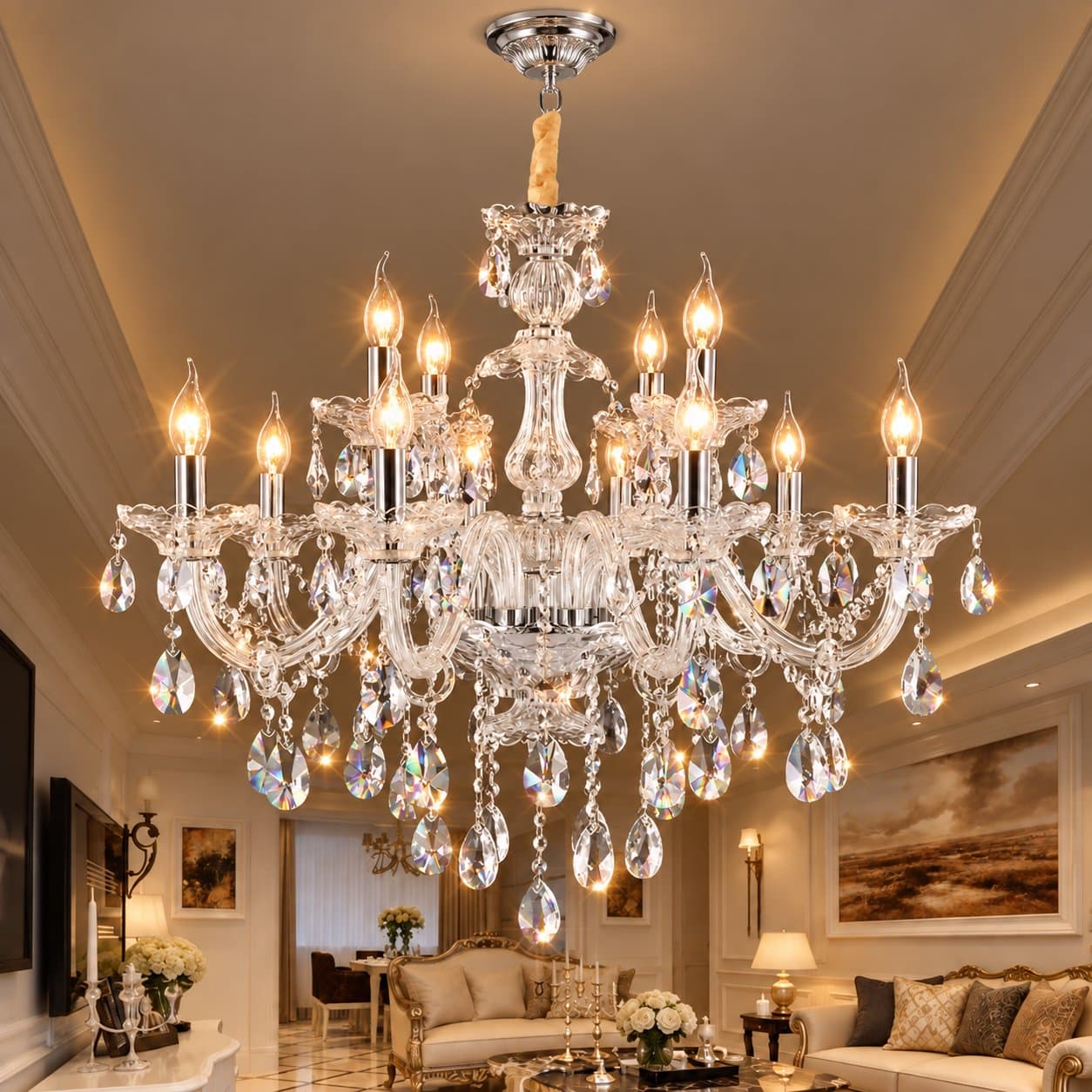
Showroom lighting is designed to make decorative lighting look impressive. Almost any polished surface can shine under strong artificial lights. What matters is how the material behaves when it is exposed to ordinary lighting in your home. A well-made crystal chandelier can produce a more noticeable sparkle because its facets redirect light in several directions. If sunlight or a strong bulb hits a prismatic piece at the right angle, it may create coloured reflections across a wall or ceiling.

A glass chandelier can produce a beautiful reflection too, but its appearance is usually more understated. This can actually be desirable in a room where you want elegant lighting without too much visual drama. The choice therefore comes down to more than material. Your interior style, room size, lighting needs, budget and personal preference all matter.

What Makes a Crystal Chandelier Sparkle?

The sparkle associated with crystals is not simply because the material is “shiny.” The cut plays a major role. A crystal piece can be shaped with multiple surfaces called facets. Each facet changes the direction in which light travels through the material. When several facets work together, the result can be a lively combination of reflection and refraction.

Think of a small prism. When light enters it, the light can bend and separate into different colors. Crystal used in decorative lighting can create a similar visual effect, although the exact result depends on the material, cut, clarity and light source. This is why cut crystal is valued in decorative lighting. Sharp, carefully formed facets can produce more noticeable flashes than pieces with simple rounded edges.

By comparison, a smooth piece with rounded edges may reflect light without creating the same level of prismatic effect. So when you look at a chandelier, do not only ask, “Does it sparkle?” Look at how it sparkles.

What Is Lead Crystal, and What Does Lead Content Mean?

Traditional lead crystals contain a significant amount of lead oxide. The lead content changes the density and optical characteristics of the material. The term “leaded crystal” is sometimes used to describe this type of crystal. Historically, higher lead content has been associated with greater density, clarity and refractive properties.

However, the presence of lead does not automatically make one chandelier suitable for every buyer. Today, there are also lead-free crystal options made using other mineral compositions. K9 optical crystal is one example commonly used in decorative products.

This distinction is useful when shopping because the word “crystal” alone does not tell you exactly what material has been used. If a supplier describes a product as crystal, ask for the material specification. Is it lead crystal? K9? Another lead-free crystal? Crystal glass? Or ordinary glass? Knowing the specification helps you understand what you are actually paying for.

Is K9 Crystal the Same as Traditional Crystal?

K9 is one of the most commonly encountered terms when shopping for decorative crystal lighting. K9 optical crystal is a genuine optical material and should not automatically be described as fake simply because it is not lead crystal. It is a lead-free crystal material with good clarity and optical properties, which makes it suitable for decorative lighting and chandelier components. This is particularly important for buyers who have been told that anything without lead oxide is not “real” crystal. That is too simplistic.

Different crystal materials exist for different purposes. A modern crystal product may use a lead-free composition while still offering attractive clarity and light refraction. The better question is not whether K9 is “real enough.” The better question is whether the supplier has clearly stated the material and whether its characteristics match what you want.

Crystal vs Glass Chandelier: How to Tell the Difference, Sparkle and Choose the Right One for Everyday Use.

How Can You Tell the Difference Between a Crystal and Glass Chandelier?

If you are comparing two chandeliers in a showroom, there are several things you can examine before buying.

1. Look at the way it reflects light

Place the decorative piece where it can receive strong natural or artificial light. Crystal can create stronger flashes, reflections and rainbow-like effects because of its refractive properties. Glass can reflect light beautifully too, but it may produce a softer glow. The effect will vary depending on the shape, thickness and cut, so do not use sparkle alone as proof.

2. Check the weight

Crystal can be heavier than glass, particularly when comparing materials with similar dimensions. This is connected to density. Traditional leaded crystal, for example, can feel noticeably dense in the hand. However, weight is only one clue. Thick glass can also be heavy, and a small crystal bead may not feel particularly substantial.

3. Try the gentle sound test

A traditional method used to identify crystals is a gentle tap. A suitable crystal piece can produce a clear, sustained ringing sound, while ordinary glass may produce a shorter or duller tone. Do not hit chandelier components hard. If a supplier allows you to test a removable piece, a gentle tap is enough.

4. Examine the clarity

Hold the piece under good lighting and inspect it closely. Higher-quality crystals can have excellent clarity, allowing light to pass through cleanly. Look for unwanted cloudiness, bubbles, rough finishing or inconsistent surfaces. Clear glass can also have excellent clarity, so this test should be used together with the others.

5. Examine the cut and facets

Look closely at the edges and surfaces. A well-finished facet should look deliberate and clean. When several facets are cut accurately, they can work together to create stronger light effects. This is particularly useful when comparing decorative crystal pieces with simple glass components. No single test can conclusively identify every material. Use several observations together and, most importantly, ask the supplier for the product specification.

Does the Cut of a Chandelier Matter?

Yes. The cut can make a major difference to the appearance of a chandelier. A chandelier may use high-quality material but still look less impressive if the decorative pieces are poorly finished. On the other hand, a carefully cut piece can make a material look considerably more attractive under the right lighting.

A facet is a flat surface cut into the material. Multiple facets can redirect light in different directions, creating shimmer and visual movement. The shape also matters. Some designs use sharp geometric cuts. Others use rounded beads, drops or sculptural shapes. A pendant may use a simpler form, while an elaborate decorative chandelier may have several layers of cut pieces. This is one reason it is useful to examine a selection of chandeliers in person or study detailed product images before making a purchase.

What Are the Different Types of Chandeliers Available?

There are many types of chandeliers, and material is only one part of the decision. Traditional crystal designs often focus on multiple decorative drops, cut pieces and a more classic appearance. These can work particularly well in formal spaces where the chandelier is intended to become a central feature.

Modern chandeliers may use geometric shapes, integrated LED lighting, metal frames and crystal or glass elements. These can suit modern interiors where the fixture needs to provide both lighting and decoration. Pendant chandeliers offer another option. They may have one dominant hanging structure or several suspended elements arranged around a central frame.

There are also sculptural designs that use unusual forms to create visual interest even when they do not rely heavily on crystal. The material, shape and lighting technology should therefore be considered together.

Is Murano Glass the Same as Crystal?

Murano is associated with a long tradition of handcrafted glassmaking, particularly decorative glass products. The important thing to understand is that Murano refers to a glassmaking tradition and origin rather than meaning that a product is automatically crystal.

Hand-blown or handcrafted glass can have its own character, variation and artistic value.  A carefully made glass chandelier can therefore be a distinctive decorative feature even though it is not a crystal chandelier.

This is a useful reminder that material and craftsmanship are two separate considerations.  A buyer interested in handmade decoration may value the craft and character of a glass piece, while another buyer may specifically want the brilliance and refractive properties associated with crystal. Neither preference is automatically wrong.

Crystal vs Glass Chandelier: How to Tell the Difference, Sparkle and Choose the Right One for Everyday Use.

Are Glass Chandeliers a Good Choice for Modern Homes?

Absolutely. Glass chandeliers often feel lighter visually, which can make them suitable for modern homes where the homeowner wants an elegant fixture without excessive visual weight.

Clear glass can work particularly well with minimalist interiors because it allows more of the room's architecture and color palette to remain visible. A glass chandelier can also produce a softer lighting effect, depending on its shape and bulbs. 

This can be useful in dining rooms, bedrooms, hallways and living spaces where the goal is atmosphere rather than intense decorative sparkle. Glass can also be a practical choice for everyday use when the homeowner prefers a simple, refined look.

Where Does Crystal Work Best in the Home?

Crystal chandeliers are often selected for spaces where the lighting fixture is expected to make a statement. Living rooms and dining rooms are common locations because these spaces often have enough visual and physical space for a decorative fixture.

A large crystal chandelier can become a focal point above a dining table, while a smaller design can add shimmer to a living room without overwhelming the interior. Crystal can also work well in entryways, bedrooms and hospitality spaces where decorative lighting is part of the overall design. The key is proportion. A large, highly decorative fixture in a small room can dominate the space, while a small chandelier may disappear in a large room.

What Is the Difference in Maintenance Between Crystal and Glass?

Both materials need care, especially in environments where dust accumulates quickly. In Nigeria, this is particularly relevant during harmattan. Fine dust can settle on decorative surfaces and reduce their clarity and shine.

Crystal can require more attention because dust sitting on multiple facets can reduce the way the material reflects and refracts light. A regular gentle cleaning routine helps maintain its appearance. Glass also needs cleaning, but its smooth surfaces may be easier to wipe depending on the design.

The frame, bulbs, beads and other components of the fixture also need consideration. Always follow the manufacturer's cleaning instructions and avoid abrasive materials that could damage delicate surfaces. Good maintenance supports both appearance and durability.

Choosing Between Crystal and Glass: What Should You Consider?

When choosing between crystal and glass, start with the purpose of the room. If you want strong optical effects, noticeable shimmer and a decorative centerpiece, crystal may suit your preference.

If you want a cleaner appearance, softer reflection and a more understated fixture, glass may be more appropriate. Budget also matters. Crystal can command a higher price, particularly when the material, cut, craftsmanship and overall construction are of high quality.

But do not assume that an expensive chandelier is automatically crystal or that an affordable glass chandelier lacks quality. Look at the complete product: material specification, frame, finishing, design, lighting performance and durability. Then ask yourself what style to choose based on the room and your personal preference rather than the price alone.

How Do You Know You Are Getting What You Pay For?

One of the most important things a homeowner can do is ask for a clear product specification. If you are told that a chandelier is crystal, ask what type. Is it lead crystal? Lead-free crystal? K9 optical crystal? Crystal glass? Or glass? A transparent supplier should be able to explain what the product is made from without using the word “crystal” as a vague description for every clear decorative material.

This is particularly important when comparing products across different price points. The goal is not simply to find the most expensive fixture. It is to understand the product well enough to decide whether its material, appearance, craftsmanship and price match your expectations.

Final Thoughts: Which Chandelier Should You Choose?

The difference between glass and crystal becomes much easier to understand when you stop looking only at the price tag. Crystal can offer stronger refraction, sharper reflections and more noticeable sparkle, particularly when the material is well cut. Traditional lead crystal has a different composition from modern lead-free crystal options such as K9.

Glass can offer clarity, elegance and a softer appearance, making it a practical choice for many modern interiors and everyday spaces. Acrylic is another material that may appear in decorative lighting and should be identified clearly rather than simply being described as crystal.

Ultimately, crystal and glass chandeliers can both be beautiful. The right choice depends on what you want from the fixture, where it will be installed, your budget and the kind of visual effect you want to create.

What to Remember Before Buying

  • Crystal and glass are different materials, but neither automatically makes a chandelier the right choice for every room.

  • Traditional lead crystals contain lead oxide, which affects its density and optical behavior.

  • Lead-free crystal, including K9 optical crystal, is a genuine material category and should not automatically be treated as fake.

  • Look at the facet, cut, clarity and finishing instead of judging a chandelier only by its sparkle.

  • Crystal can be heavier than glass, but weight alone cannot prove what a material is.

  • A gentle sound test can provide a useful clue, but it should not be your only test.

  • Glass chandeliers often feel visually lighter and can produce a softer reflection that works well in modern interiors.

Crystal vs Glass Chandelier: How to Tell the Difference, Sparkle and Choose the Right One for Everyday Use.

Similar Articles

Crystal vs Glass Chandelier: How to Tell the Difference, Sparkle and Choose the Right One for Everyday Use. | Steadfast